Cyclops marinus
Smilla's Sense of SnowCyclops marinus is a water flea and the intermediate host in the Arctic worm’s life cycle. In the shipboard laboratory, Tørk uses a specimen to explain how the parasite develops in water fleas before reaching a larger host, making this inconspicuous organism a key link in the novel’s account of an emerging infection.
Identification and Observation
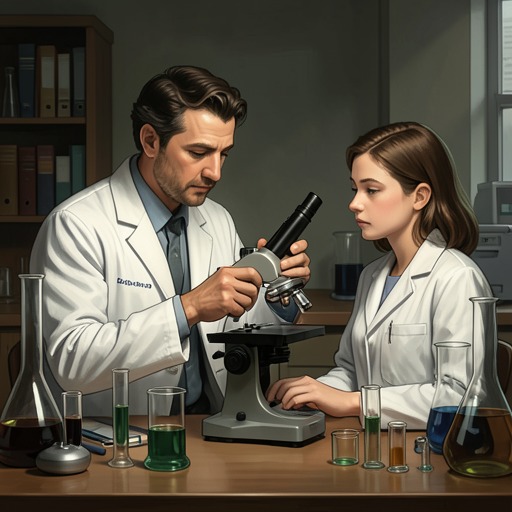
Tørk identifies the specimen under a dissecting microscope as Cyclops marinus, describing the water flea, or its relatives, as present in oceans around the globe. He has added a small amount of hydrochloric acid to keep it still for examination. At first, Smilla sees what appears to be the flea’s digestive system; Tørk corrects her, directing attention to a bright channel along the animal’s back. What looks like an internal organ is a worm.
The scene turns an apparently ordinary laboratory specimen into evidence of a relationship between species. Tørk’s explanation is grounded in what the microscope reveals, but the larger implications depend on his account of the parasite’s life cycle and its experiments with new hosts.
Role in the Arctic Worm’s Life Cycle
The Arctic worm releases larvae into the sea when a mature female encounters Cyclops in the surrounding water. The water fleas eat the larvae, which then develop inside them over several weeks. When a flea carrying the parasite enters a larger mammal through seawater, it breaks down and releases the larva into that host. In Tørk’s account, the parasite then matures, reproduces, and moves to the host’s subcutis, completing its cycle.
The water flea is therefore neither the parasite’s final host nor merely incidental to its spread. It is the intermediate environment in which the larvae develop before passing to a larger animal. Tørk says that neither the flea nor the mammal appears to be harmed by the ordinary cycle, presenting the parasite as one adapted to coexist with its hosts.
Ecological Limits and Human Infection
Tørk describes the Guinea worm as a close relative of the Arctic worm and uses it to explain how environmental conditions and host relationships can constrain a parasite. The Guinea worm depends on heat and stagnant water; rainfall and flowing, cooler water make conditions less favorable. He presents this balance as a check on transmission and emphasizes that a successful parasite ordinarily does not kill its host.
That ecological restraint is what makes the Arctic worm’s altered behavior alarming. After Loyen collected infected samples from water around the stone, he spent twenty-five years investigating how the larva could be grafted onto living human tissue. Tørk says it had adapted to the human immune system: it could pass through the mouth’s mucous membranes and form a protein-derived covering that made it resemble part of the human body. In humans, its growth, mating, and movement through the body took days rather than the months required in marine mammals.
Tørk and Verlaine had also grafted larvae onto saltwater and freshwater fish of different sizes and kept them at varying temperatures. Tørk says the parasite adapted to every fish tested. In his interpretation, this flexibility removes an important restriction on dispersal: the limited range of hosts capable of transmitting it. The water flea’s role thus sits within a wider change in the parasite’s ecology, as adaptation broadens possible routes between environments and hosts.
Narrative Significance
Cyclops marinus gives the novel a concrete, observable point of entry into a larger scientific explanation. The microscope first presents the flea as a small specimen; the parasite visible within it then connects the lake around the stone to marine animals, human infection, and the consequences of laboratory experimentation. The organism matters not as a threat in itself, but as a necessary link in a cycle whose balance is destabilized when the parasite becomes capable of developing rapidly in people.